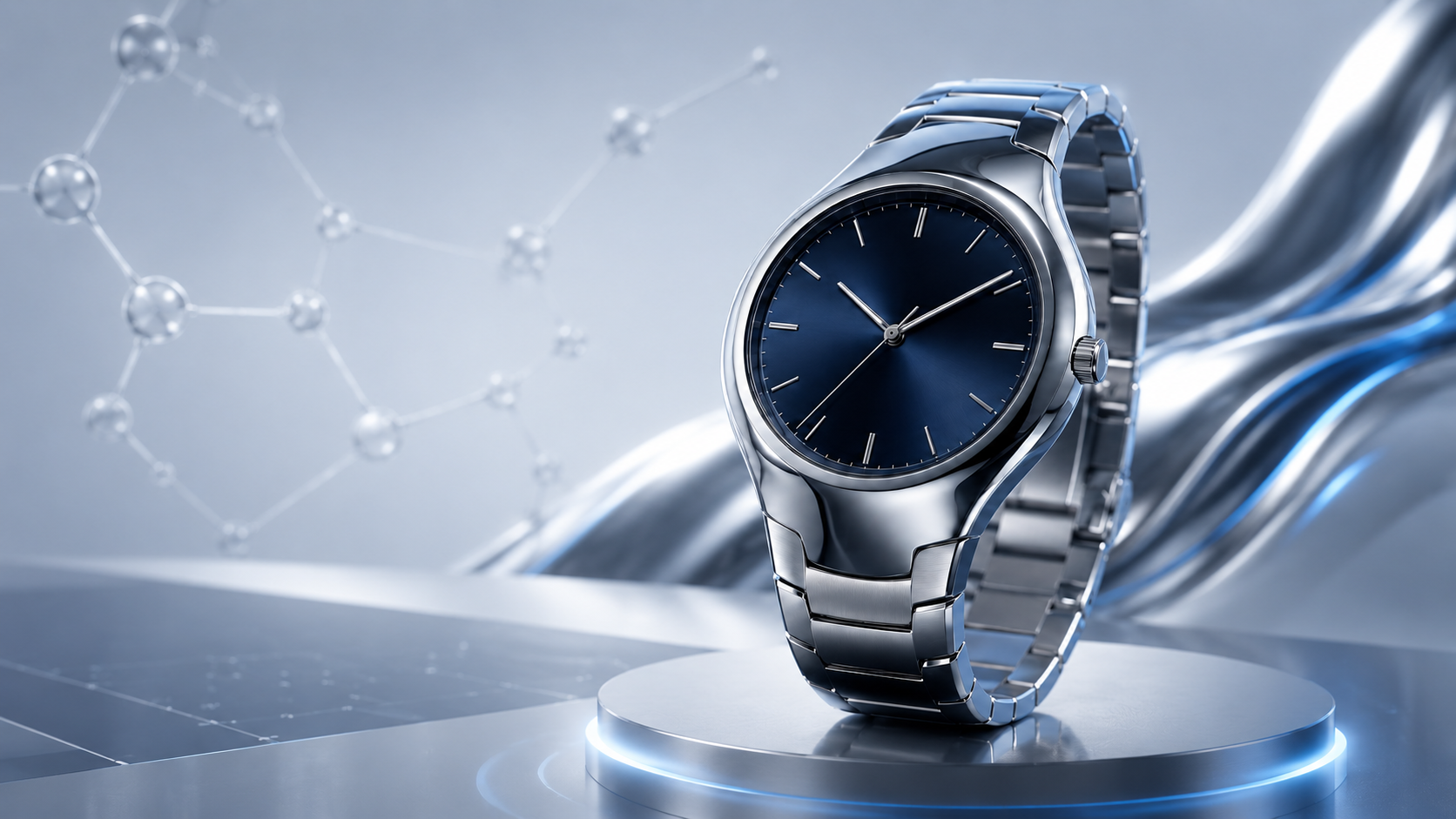
Material Properties

Amorphous metal, also known as metallic glass or bulk metallic glass, features a non-crystalline atomic structure that gives it unique advantages in strength, elasticity, corrosion resistance and precision forming.
Traditional metals usually have a crystalline atomic structure with grains and grain boundaries. Amorphous metals are different. Their atoms are arranged in a disordered, glass-like structure, which helps create a unique combination of mechanical performance, surface stability and forming precision.
Amorphous metal is a metallic material without a long-range ordered crystal structure. During rapid cooling, atoms are frozen before they can arrange into regular crystal lattices, preserving a non-crystalline atomic structure.
Because of this structure, amorphous alloys are also commonly called metallic glass or bulk metallic glass when they can be formed into larger three-dimensional parts.
The grain-free and grain-boundary-free structure is the main reason why amorphous metal can offer high strength, excellent elasticity, corrosion resistance and dimensional stability.
Traditional metals such as stainless steel, aluminum alloy and titanium alloy usually contain crystalline grains. Grain boundaries may become weak regions where deformation, corrosion or fatigue damage can begin.
Amorphous metals do not have conventional grains or grain boundaries. This gives the material a more uniform structure and allows it to perform reliably in demanding applications that require strength, precision and long service life.
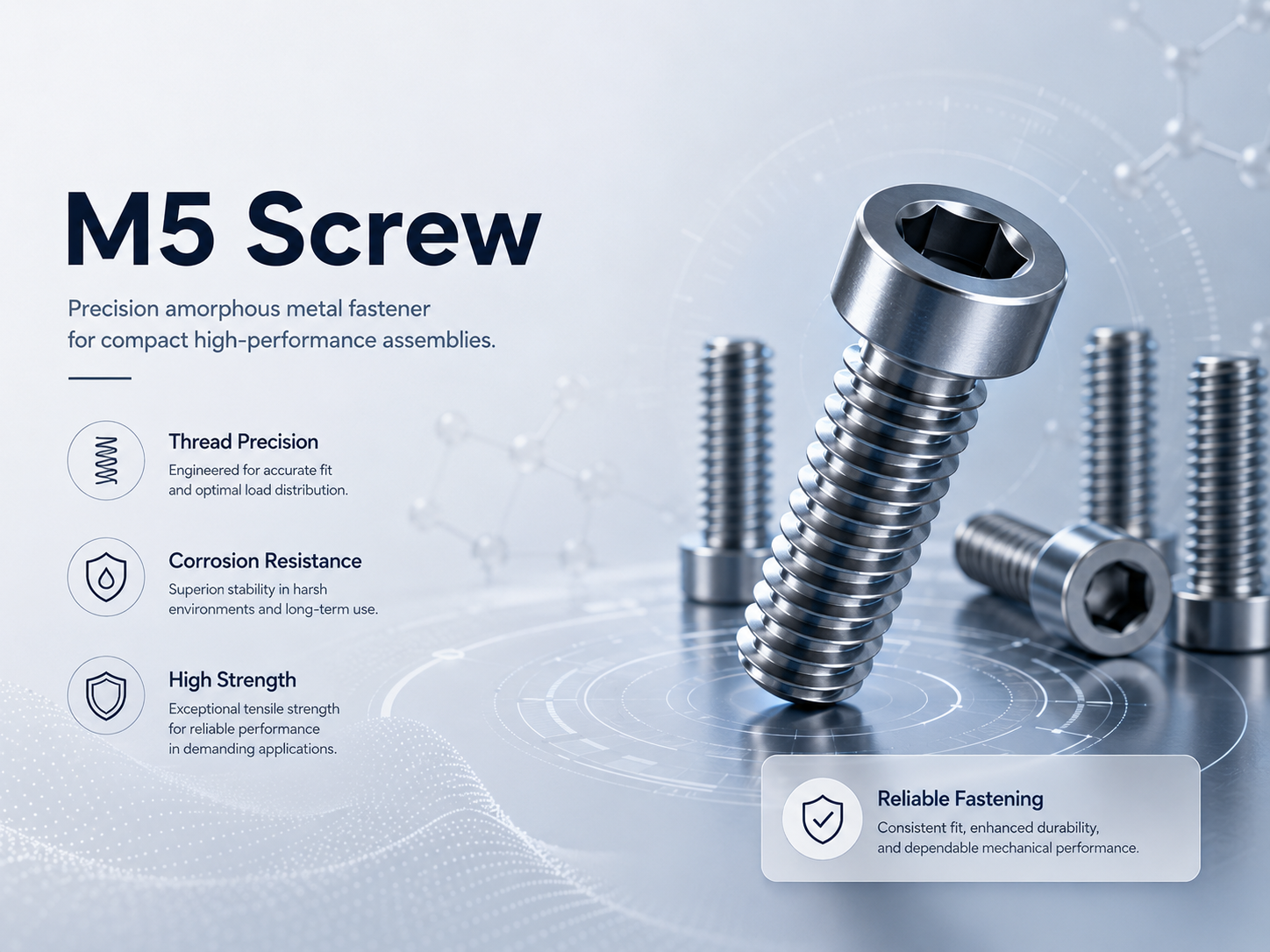
Amorphous metal can provide excellent strength and structural stability for precision components.
Its elastic recovery helps components resist deformation under repeated stress or impact.
The uniform structure supports strong corrosion resistance in industrial, medical and consumer applications.
Amorphous alloys can be formed into complex shapes with high dimensional accuracy and smooth surface quality.
Amorphous metal is suitable for high-end applications where traditional materials may not meet the requirements of strength, lightweight design, wear resistance, corrosion resistance or precision forming.
The unique non-crystalline structure of amorphous metal makes it an advanced material for next-generation precision components. It combines strength, elasticity, corrosion resistance and forming accuracy, providing new design possibilities for industrial, consumer, medical and robotic applications.
Send us your drawings, dimensions or application requirements for technical evaluation.